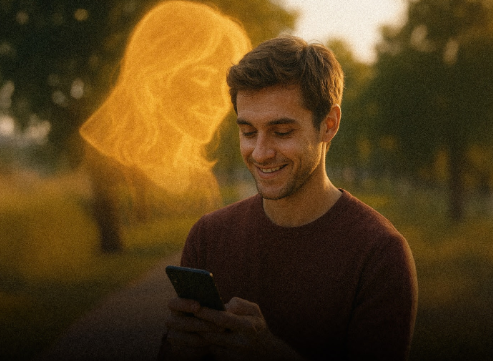
Not butterflies-nervous. Actually nervous. The kind where a simple “Want to grab coffee?” turns into a full internal debate before you even hit send.
So here’s what’s strange: something has started to shift. Quietly. Slowly. But it’s real.
It’s not that dating got easier. It’s the reasons it felt so hard, like fear, guesswork, and isolation, that are starting to shrink. And the tools doing the shrinking? They’re already in your pocket.
This is how.
1. Dating Apps Make Starting Easier
Picture what it used to take to hit on someone in real life.
You had to spot them. Figure out if they were single. Read a dozen signals. And then somehow say something that didn’t land like a brick.
Dating apps skip most of that. Everyone on there has already raised their hand. The ambiguity is gone. And when the ambiguity is gone, so is a huge chunk of the pressure.
The numbers back this up. In 1998, only about 2% of married couples met online. By 2017, it was nearly half.
Online dating didn’t just become an option. It became the option for a growing number of people. Pew Research found that 30% of U.S. adults have used a dating app, and among people under 30, that number jumps to 53%.
Here’s why that matters for confidence: when you have more shots on goal, no single one feels like life or death. You’re not betting everything on one conversation at one party. The stakes per interaction drop. And that makes it so much easier to actually show up.
2. Safety & Trust Technology Reduces Fear Before the First Date
There’s a voice most online daters know well. It goes: “But what if this person isn’t real?” That voice used to have a point.
Fake profiles and scam accounts were everywhere, and there wasn’t much anyone could do about it. But platforms are catching up fast. And the results are hard to ignore.
Bumble launched an AI tool called Deception Detector designed to automatically block fake and scam accounts. In testing, it caught 95% of the ones flagged as suspicious. Within two months, user reports of scams and fake profiles dropped by 45%. That’s not a patch. That’s a real dent.
Verification is having an effect too. When Tinder tested ID verification in Australia and New Zealand, verified users got 67% more matches than people who hadn’t verified.
People aren’t just tolerating verification, they’re rewarding it. When you verify, you’re not just proving you exist. You’re joining a group that others trust.
Less fear of being tricked means less hesitation before engaging. It’s that simple.
3. Virtual First Dates Lower Pressure and Improve Screening
For a while, a video call as a first date sounded like settling. Like the real date was still coming later, and this was just the warm-up. Turns out, that assumption was wrong.
A 2026 study analyzed over 4,500 real blind dates. Some virtual, some in person. The finding?
Virtual and in-person dates were almost identical in terms of how much people enjoyed themselves, how attracted they felt, and how positively they saw the other person. When you controlled for how long each date lasted, virtual dates actually came out ahead.
The confidence play here isn’t about replacing in-person dates. It’s about removing the barrier to the first one. When showing up feels lower-stakes. No commute, no outfit stress, an easy exit if the vibe’s off. More people are willing to try. And trying is where confidence lives.
4. Mental Health & AI Tools Help People Practice Confidence, Not Fake It
This is the section that matters most for anyone who’s ever thought: “I want to put myself out there. I just… can’t seem to do it.”
That feeling has a name. For a lot of people, it’s social anxiety. And for a long time, the advice was basically: just get over it. Push through. Be brave.
That advice is lazy. And now, there’s actual science showing a better way.
Therapy apps are working. A study tested an app-based program combining cognitive behavioral therapy with virtual reality on people with social anxiety. Forty percent of them showed real, measurable improvement — compared to just 11% in the control group who were just waiting. Twenty-three percent reached full remission. The waitlist? Three percent.
Those aren’t small numbers. That’s a tool that actually works.
AI companions are doing something unexpected, too. Some of the best AI girlfriend apps were originally designed for entertainment. But researchers at Harvard found something more interesting.
People who talked to an AI chatbot felt less alone afterward. On par with how they felt after talking to an actual person. And more than after watching YouTube, which is what most people do when they’re lonely and don’t know what else to do.
The reason it worked wasn’t complicated. It came down to one thing: feeling heard.
When people felt like something was actually listening and responding to them, their loneliness dropped. Not permanently. But enough. Enough to make the next real interaction feel a little less terrifying.
Technology Doesn’t Create Confidence — It Removes Barriers
Confidence in dating doesn’t come from feeling invincible. It comes from feeling like the situation is manageable.
Every tool in this list works the same way. Not by making you bolder. By making the thing you were afraid of a little smaller.
Bigger pools make any single rejection sting less. Verification makes the unknown feel safer. Video dates make showing up feel easier. Anxiety tools quiet the voice that says stop. And sometimes, just feeling heard even by an AI at 2 a.m. is enough to remind you that connection isn’t as far away as it felt.
The technology isn’t doing the hard part. It never could. But it’s clearing the path to it. And for a lot of people, that’s exactly what was needed.