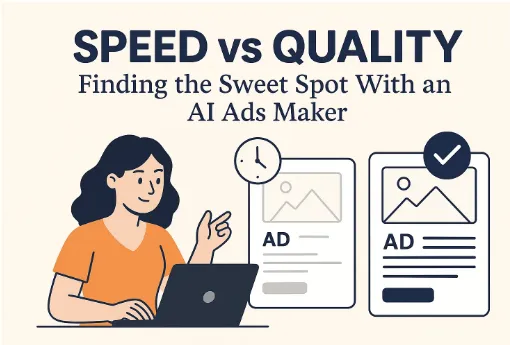
1. Why “Fast and Good” Is the New Non‑Negotiable
Today’s auction algorithms reward cadence: the more variants you push, the quicker you exit the learning phase and find winning combos. At the same time, consumers punish sloppy creative with scroll‑by apathy. An AI ad maker bridges the gap by automating grunt work (copy drafts, design layouts, format resizing) while still letting you steer strategy and quality.
Quick reality check: Drafting ten fully‑formatted ad variants manually might take a day. With an AI ads maker, it’s closer to an hour—without sacrificing cohesion.
2. Hard‑Code Your Quality Standards First
Speed without standards is just spam. Before you crank out assets, lock in the rules:
Voice: Friendly, lightly authoritative
Goal: Highlight quick results
Limits: CTAs ≤ 8 words • No generic phrases (e.g., “Sign Up Today”)
Tone to avoid: Hypey superlatives (“miracle,” “revolutionary”)
Enter these parameters into your AI ads maker’s prompt or brand‑guide fields so every auto‑generated headline, body line, and CTA hits the mark on the first pass.
Actionable prompt:
“Write 5 CTAs for a mid‑ticket SaaS. Friendly tone, emphasize speed, max 8 words, no clichés.”
3. Lean on Built‑In Performance Scoring
Most leading AI ads makers now surface predictive metrics—click‑through potential, clarity scores, even heat‑map previews. Use that intel to kill weak variants before they cost impressions.
- Generate 15 options.
- Sort by score.
- Deploy only the top third.
In seconds, you’ve filtered the noise—and kept velocity intact.
4. Keep Humans in the Loop for Nuance
Algorithms can spit out a polished headline, but they still struggle with cultural nuance, insider jokes, or regional slang. Establish a rhythm:
- Bulk Generation: Let your AI ads maker draft at scale.
- Micro Review: Spend 10 minutes scanning for tone or context misses.
- Green‑Light & Go: Approve winners, send to the scheduler, and move on.
The human touch turns automated output into brand‑safe creative.
5. Templates & Modular Frameworks—Your Speed Multiplier
A solid template library means you’re never starting from zero. Pair that with modular CTAs and benefit blocks stored in your prompt bank, and you can build full ad suites like LEGO® sets:
- Design Templates: Pre‑approved colors, fonts, logo placement.
- Copy Modules: Tested CTAs, benefit bullets, credibility blurbs.
- Persona Sets: Saved audience descriptions ready to plug into prompts.
Result? You tweak a few variables and hit “generate” instead of rewriting from scratch.
6. Iterate in 48‑Hour Sprints
Speed + quality is a flywheel, not a finish line. A simple cadence keeps it spinning:
- Day 1 Morning: Generate, score, and schedule variants.
- Day 2 Lunch: Check dashboards; pause laggards.
- Day 2 Evening: Feed top performers back into prompts for version 2.
Each loop sharpens both message and design while maintaining rapid turnaround.
7. Common Pitfalls to Dodge
| Misstep | Why It Hurts | Quick Fix |
| Over‑reliance on default prompts | Generic copy, unclear positioning | Write prompts with voice, benefit, length, and banned‑word rules |
| Ignoring predictive scores | Wastes spend on low‑probability ads | Deploy only variants above your score threshold |
| “Set‑and‑forget” mindset | Creative fatigue sets in quickly | Review dashboards every 48–72 hrs and refresh prompts |
| Skipping human QA | Risks cultural misfires or off‑brand jokes | Allocate a 10‑minute final scan per batch |
Final Word
Choosing between speed or quality is yesterday’s problem. With the right workflow, an AI ads maker delivers both: lightning‑fast variant production and a safety net of prompt rules, predictive scoring, and human oversight. Treat your tool as a creative accelerator, not a replacement for judgment, and you’ll out‑iterate slower teams—without ever lowering your bar.
Ready to spin the flywheel? Draft your quality guidelines, fire up your AI ads maker, and watch “fast + great” become your new default.