For as long as music has existed, there has been a distinct, often painful divide in the creative world. On one side, you have the musicians—the people who understand chord progressions, who can strum a guitar, program a drum machine, or visualize a melody on a staff. On the other side, you have the writers.
The writers are the ones with the “Notes” app on their phones full of poetry. They are the ones who scribble couplets on napkins in coffee shops. They have the stories, the emotions, and the rhythm of the words locked in their heads. But because they cannot play the piano or produce a beat, their songs remain silent. They are “silent songwriters,” dependent on finding a collaborator to unlock their art.
In 2026, that dependency is officially over.
We are witnessing a fundamental shift in how music is created. It is no longer about physical dexterity on an instrument or years of music theory education. It is about the purity of the idea. The barrier to entry has been lowered to a single skill: the ability to write.
At the forefront of this shift is a technology that acts as a bridge between the written word and the produced track: the AI Lyrics into Song generator. This isn’t just a tool; it is a new instrument for the non-musician.
Here is a deep look at how this technology works, why it matters, and how you can use it to turn your silent notes into studio-quality tracks.
The Mechanics of “Text-to-Audio” Synthesis
To understand why this is revolutionary, we have to understand how it differs from what came before. In the past, “singing AI” was mostly a novelty—robotic, flat, and devoid of soul. It sounded like a GPS trying to rap.
The new generation of engines, specifically the architecture behind the AI Lyrics into Song platform, operates on a much more sophisticated level. It doesn’t just “read” text; it interprets musicality.
1. Prosody and Rhythm Analysis
When you feed lyrics into the system, the AI analyzes the “prosody”—the natural rhythm, stress, and intonation of speech. It calculates the syllable count of your lines to determine the meter.
- If you write short, punchy lines, the AI understands this might fit a Punk or Trap flow.
- If you write long, flowing, descriptive sentences, the AI adapts the melody to be more lyrical, perhaps fitting a Folk or Ballad style.
2. Emotional Contextualization
The AI performs a sentiment analysis on your words. It looks for keywords and thematic structures.
- Words like “sorrow,” “rain,” “missing,” or “yesterday” might trigger a minor key progression with a slower tempo.
- Words like “fire,” “tonight,” “dance,” or “won” will trigger major keys, uptempo beats, and energetic vocal delivery.
3. Genre-Specific Vocal Synthesis
This is perhaps the most impressive feat. The tool doesn’t just apply a generic voice. It models the performance style of the genre you select. A Country song requires a bit of a twang and a slide in the vocals. A Metal song requires grit and distortion. The AI adjusts the “timbre” of the synthetic voice to match the musical backing, creating a cohesive track that sounds like a band playing together, not a voice pasted over a beat.
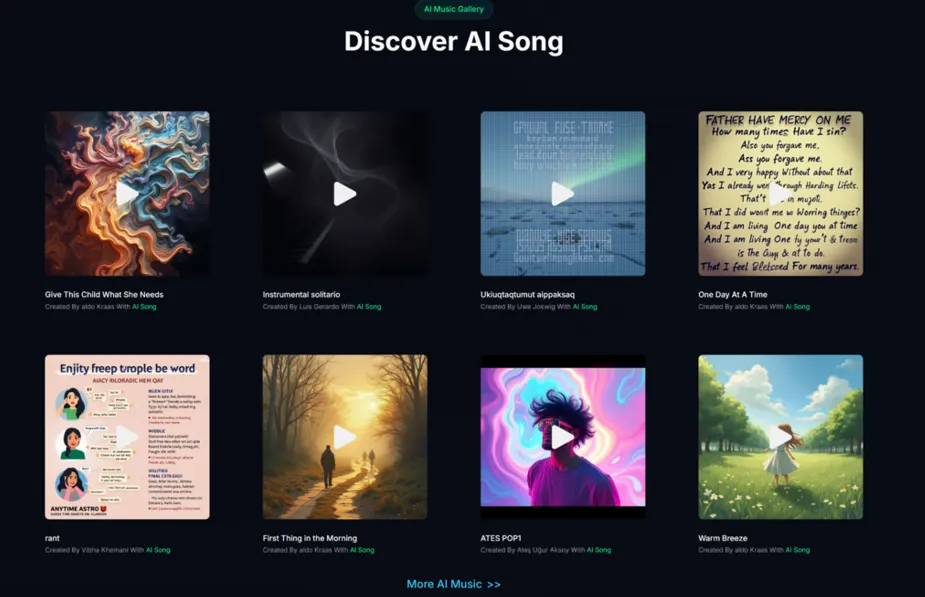
A Guide to the New Workflow: From Text to Track
If you are a writer, a poet, or a content creator, you already have the raw materials. The AI Lyrics into Song tool is simply the factory that processes them. However, like any instrument, there is a technique to getting the best results.
Here is a structured approach to mastering this workflow.
Phase 1: Structure Your Input
The AI is smart, but it loves structure. Don’t just paste a wall of text. Use “tags” to guide the composition.
- [Verse]: Keep your storytelling here. The AI will generally keep the melody stable and repetitive in these sections.
- [Chorus]: This is your hook. The AI knows that a section marked “Chorus” needs to be louder, higher in pitch, and more dynamic.
- [Bridge]: Use this for a shift in perspective or tempo.
- [Outro]: Signal the end of the song.
By formatting your text with these brackets, you are effectively acting as the “Arranger” of the song.
Phase 2: The Genre Experiment
One of the most powerful creative exercises you can do is “Genre Hopping.”
Take a poem you wrote about a breakup.
- Run 1: Generate it as a Sad Piano Ballad. The result will be expected—melancholic and tear-jerking.
- Run 2: Generate the exact same lyrics as an Upbeat 80s Synth-Pop track.
Suddenly, the song transforms. The sad lyrics combined with the happy music create a complex feeling of “dancing through the tears.” This ability to instantly hear your words in different musical contexts allows you to understand the emotional versatility of your own writing.
Phase 3: Refinement and Iteration
Rarely is the first take perfect. The beauty of AI is the speed of iteration. If the AI rushes through a line, you can go back to the text, add a comma or a line break to force a pause, and regenerate. You are sculpting the song in real-time, using punctuation as your musical notation.
Beyond the Hobbyist: Professional Use Cases
While this is a dream come true for the “closet songwriter,” the commercial applications of AI Song are disrupting several industries.
1. The Content Creator’s Copyright Shield
For YouTubers, Streamers, and Podcasters, music licensing is a nightmare. You spend hours finding a song, only to get a copyright claim that demonetizes your video.
By writing your own simple lyrics (or even using the AI to help write them) and generating a custom track, you own the asset. You are creating a unique sonic identity for your channel that no one else has, and more importantly, you are immune to DMCA strikes because you hold the commercial rights to the generation.
2. The Marketing “Jingle” Revolution
Small businesses usually rely on generic stock music for their Instagram Reels or TikTok ads. It’s forgettable.
Imagine a local coffee shop owner. Instead of stock jazz, they write:
“Wake up slow, smell the roast / Best latte on the West Coast / Come to Java Joe’s.”
They run this through the generator with a “Lo-Fi Chill” setting. Instantly, they have a custom brand anthem. It’s catchy, it’s relevant, and it cost them zero dollars in studio fees.
3. Educational Tools
Teachers are finding that students retain information significantly better when it is set to music. A history teacher can take the dates of the Civil War, format them as rhymes, and generate a catchy Hip-Hop track. Suddenly, the students aren’t memorizing dates; they are memorizing lyrics.
The Philosophical Shift: Collaboration, Not Replacement
There is a valid fear among musicians that AI is here to replace them. But when we look at tools like AI Lyrics into Song, the reality is more nuanced. It isn’t replacing the artist; it is expanding the definition of who can be an artist.
It allows the lyricist to prototype. A professional songwriter might use this tool to create a “demo” to send to a real band. “Here is the vibe I’m going for,” they might say, sharing the AI-generated track. It becomes a communication tool.
For the non-musician, it is a tool of liberation. It validates the time spent writing poetry. It proves that those words do have a melody, even if you didn’t have the voice to sing them yourself.
Conclusion: Your Studio Awaits
The era of the “silent songwriter” is ending. The barrier between the feeling in your heart and the sound in your speakers has never been thinner.
Whether you want to create a heartfelt anniversary gift, a banger for your next YouTube intro, or simply finally hear that poem you wrote in high school come to life, the technology is ready. AI Lyrics into Song generator is your session band, your producer, and your vocalist, all waiting for your command.
Open your notes app. Copy that text. And hit generate. The world is ready to hear what you have to say.